


The Gobius difference
A level is not a volume
Most tank indicators read how high the liquid stands and call it a percentage. That works in a box, and almost no tank is a box anymore. Gobius shows what is actually in the tank.
One
Half the height is not half the tank
Tanks used to be boxes. Today they are shaped to fit the space they live in: tapered to follow a hull, saddled over a shaft, stepped around a wheel arch.
Float senders, pressure sensors and ultrasonic gauges all read how high the liquid stands and assume a box. On a rectangular tank that is close enough. On a tapered one, half the height can be a third of the contents, and the error is worst near empty, where you care most.
Gobius C measures the real volume, and the Tank Calculator turns it into true litres for your tank’s exact shape. Other gauges show a level. Gobius shows the volume.
Two
Nothing goes inside the tank
A float or a probe has to sit in the liquid to do its job — and that is the whole problem. In black water it fouls; in fuel it corrodes. It fails where you cannot reach it.
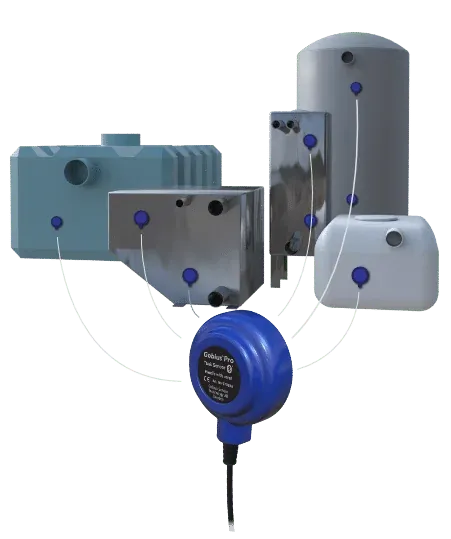
Gobius stays outside and reads through the wall. Nothing to gum up, nothing to rinse, nothing to replace each season. The sensor you fit is the sensor you keep.
Three
The waste tank stops being a guess
The waste tank is the one no one wants to open—and the one that will ruin your weekend if it overflows. Moreover, it houses the worst “senders” on board; dealing with one has always meant putting something into it.
Read from outside it becomes an ordinary tank. Set the alarm early and you hear about it in time to act: an errand past the pump-out rather than a crisis on Sunday afternoon.
Four
Accurate enough to plan on
A warning lamp tells you something is wrong now. Knowing you have 30 % left tells you you have a while yet — and lets you decide what to do with it.
The radar in Gobius C reads the distance to the surface to within 2 mm — no float to stick, no track to corrode, nothing that quietly starts reading low. Where you read it is up to you, and each step is optional.
On your phone
Fit the sensor, open the free app, read the volume over Bluetooth.
On the boat’s monitor
With Gobius C for NMEA 2000, the tanks appear alongside depth and speed readings.
From home
With Gobius C and a Victron Cerbo GX aboard, in the same dashboard as the batteries.
Being straight about it
The one exception
The tank wall has to let the signal through. On plastic, polyethylene and fibreglass, Gobius C is fully external. Radar will not pass metal, so a metal tank needs a small port in the top — or Gobius Pro, which reads any material from the side.
Which one suits your tank?
They answer different questions. Compare them, or see where each one goes.