


Support · How it works
How Gobius reads a tank from the outside
No float, no probe. Two different pieces of physics, both applied from outside the tank wall.
The starting point
Why measure from outside at all?
Every classic tank level indicator has one thing in common: part of it lives in the liquid. That is where the trouble starts.
Nothing to foul
A float or probe sitting in black water collects exactly what you would expect. A Gobius sensor never touches the liquid, so there is nothing to gum up and nothing to clean.
Nothing to corrode
Diesel, waste and salt air are hard on metal parts and wiring inside a tank. Ours stay dry on the outside, in normal air, where you can see them.
No new leak path
Every hole in a tank is a seal that can weep, smell or fail years later. If you never cut one, you never own that problem.
Retrofit in an afternoon
No draining, no emptying, no removing the tank. Fitting takes about 15 minutes, on the tank you already have, with the liquid still in it.
Method 1 · Radar
Gobius C: look down through the tank wall and time the echo
Our main sensor. It sits on top of the tank and reads the exact volume, stepless, from 0 to 100 %.
The unit sends a very short, very weak radio pulse straight down, the pulse bounces off the liquid, and the sensor times how long it took to come back. Longer trip, lower level — the trick a bat uses, with radio waves instead of sound.
The clever part is the wall. Plastic and fibreglass are effectively transparent to radar, the way glass is to light, so the sensor looks through the tank top and measures the surface below. Nothing enters the tank.
Because it reads a real distance rather than a switch point, the number keeps moving as the tank fills and empties — not four steps on a gauge.
Metal tanks: radar does not pass through steel, stainless steel or aluminium. On a metal tank, Gobius C fits through a small hole in the top with an adapter—still nothing hanging in the liquid, but it is no longer a fully external install. If you would rather not open the tank at all, that is what Gobius Pro and Original are for.
Radar, in three steps
What actually happens, from fitting to reading
- 01
The sensor goes on top
Clean a flat spot on the tank top and mount the sensor. On plastic and fibreglass that is the whole mechanical job — no hole, no tools in the tank.
- 02
You tell it what full means
A short calibration in the app pairs the distance the radar sees with the shape of your tank, so you read a share of the actual litres — not just of the height.
- 03
It measures, many times a second
The volume updates constantly, so you can watch a tank fill or a pump run down in real time.
Why a moving boat or RV does not make the number jump
The surface in a tank is never still — it tilts when you heel and slaps when you slam, and a raw distance reading would flicker. Gobius C takes many readings and calculates where the true surface sits beneath all that motion. What you see is a steady volume. A road or a railway does the same on a smaller scale, and the same correction handles it.
Method 2 · Vibration
Gobius Pro: knock on the wall and listen
Reads from the side, on any tank material, and tells you when the liquid passes the heights you picked.
You already know this one. Knock on a tank: below the liquid line it sounds dull, above it rings. Liquid damps the ring; air does not. Each Gobius Pro sensor gives the wall a tiny tap and listens to the answer.
Because it listens to the wall itself rather than sending a signal through it, the material does not matter — steel, stainless steel, aluminium, plastic or fibreglass, glued on the outside, nothing entering the tank. The limit is the tank wall thickness.
The trade-off is what you get back. One sensor answers one question: is the liquid above or below this point? It is an alarm system.
- Any material
- 100 % external
- Reads from the side
- Alarm points

Same idea on every tank: the sensor stays on the outside
Comparing against other technologies instead? See radar vs ultrasonic and Gobius vs SeeLevel. Longer background reading lives in the guides.
Choosing
So which one do I want?
Start with what you need from the tank, not with a product. The three cases below cover almost everyone.
Want the exact volume?
A real percentage that moves as you use the water or fuel — that is Gobius C, and on plastic or fibreglass it stays completely outside the tank.
Metal tank, or side-only access?
If you can't or will not open the tank, and the wall is steel, stainless steel, or aluminum, Gobius Pro or Original will still work from the outside..
Don't know your tank's real volume?
Odd shape, no paperwork, a builder's guess? The Gobius Tank Calculator uses your Gobius C sensor to build a level-to-volume profile as you fill, so you learn the true capacity from outside the wall.
On your phone
What the app shows you
Both sensors, C and Pro, talk to the free Gobius app over Bluetooth. No hub, no cloud account, no subscription.
Every tank you have fitted, side by side, each with its own name. Gobius C tanks show a live percentage and the volume left; Gobius Pro tanks show whether each point is wet or dry.
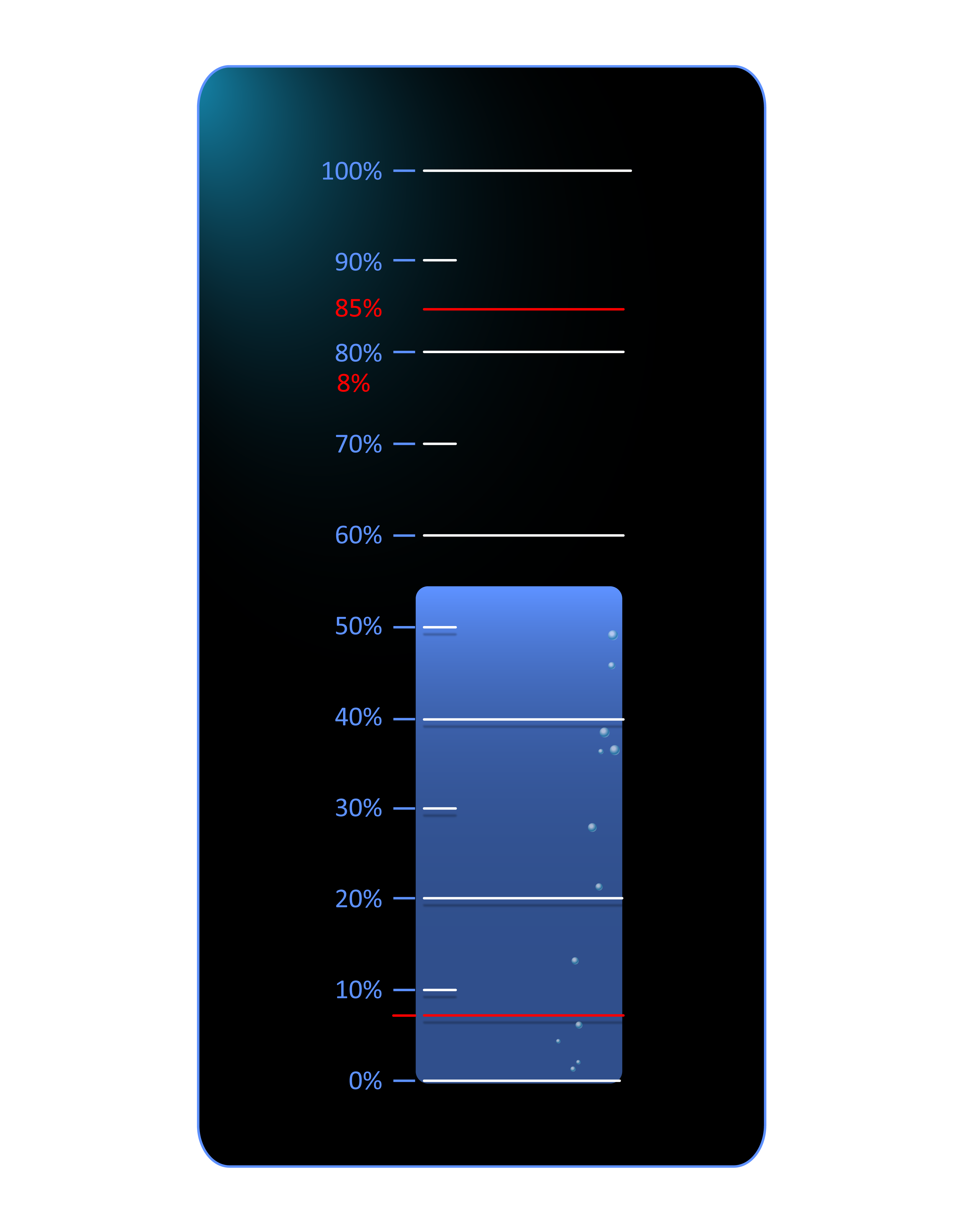
You set the warning levels yourself — 75 % on the waste holding tank, 20 % on fresh water — and the app walks you through installation.
Manuals and data sheets: downloads.
Questions
How it works — the usual follow-ups
Does the Gobius C really see through the tank wall?
Through polythelene and fibreglass, yes — those materials are transparent to radar in the way glass is transparent to light. The sensor sits on top of the tank and measures the surface below it without anything passing into the tank. Metal is the exception: it blocks radar completely, you need a hole.
Is the radar safe? Is it strong?
It is a micro-radar: very short pulses at very low power, far below what a mobile phone puts out, aimed down into your own tank. It is designed for exactly this job and nothing else.
Won't sloshing make the reading useless?
No. Gobius C takes many readings and filters out the motion to find the true surface underneath, so the volume you see stays calm even when the boat or vehicle is not. Gobius Pro is unaffected for a different reason: each of its points simply reports fluid or not.
Why doesn’t Gobius Pro give me a percentage?
Because of what it measures. Each sensor reads whether liquid is behind the sensor spot on the wall — a yes or no at that height. Several sensors give you a more steps, but never the smooth, stepless number that radar gives. If you want an exact volume, choose Gobius C.
Does either method care what the liquid is?
Fresh water, grey water, black water, diesel, petrol and oil are all handled. Nothing touches the liquid, so aggressive or dirty contents cause no wear—which is why waste holding tanks are such a common use.
How long does fitting take?
About 15 minutes per sensor on a normal tank, plus a short calibration in the app, and the tank can stay full and where it is. After that there is nothing to maintain: no moving parts, nothing inside the tank. Step-by-step instructions are in the installation guides.
Is there anything to maintain later?
No moving parts, and nothing inside the tank to clean or replace. Once a sensor is calibrated, it is left alone. If a reading ever looks wrong, start with troubleshooting.
Now you know how it works
The next question is which sensor suits your tank. That takes about a minute.