


Integration · one sensor, three rungs
From a stick in the tank to checking the boat from home
Every Gobius installation starts the same way: a sensor on the outside of the tank. What changes is how far the reading travels — to your phone, to the boat’s own screens, or to your kitchen table.
- Your phone
- The boat’s screens
- Victron GX, from home
The short version
One sensor, three rungs
Each rung is optional. Most people stop at the first one, and that is fine.
- 01
Just me and my phone
Fit the sensor, open the free app, and read the volume and level over Bluetooth. Nothing else is needed.
- 02
On the boat’s own screens
Every tank on the NMEA 2000 network, so volumes sit beside depth and speed on the plotter.
- 03
From anywhere, over the internet
A Victron GX device and a connection aboard, and the tanks appear in the same dashboard as the batteries.
Climbing changes nothing about the sensor or where it sits, only what you connect it to. What decides how far you can go is the variant you buy — so if rung two or three is even a maybe, take the NMEA 2000 one now.
Rung one
Just me and my phone
Right now it is a hatch, a torch and a stick down the filler — or a sender that has never been right. Small boat, few systems, no appetite for a wiring project.
Fit the sensor on top of the tank, open the free Gobius app, and the level and volume are on your phone. Nothing goes inside the tank, nothing connects to the rest of the boat, no hub, no account. The app is free on iOS and Android and supports ten languages.
One honest limit: Bluetooth is short-range. Rung one means you are aboard, or standing next to the boat on the pontoon. That is exactly why the other two rungs exist.
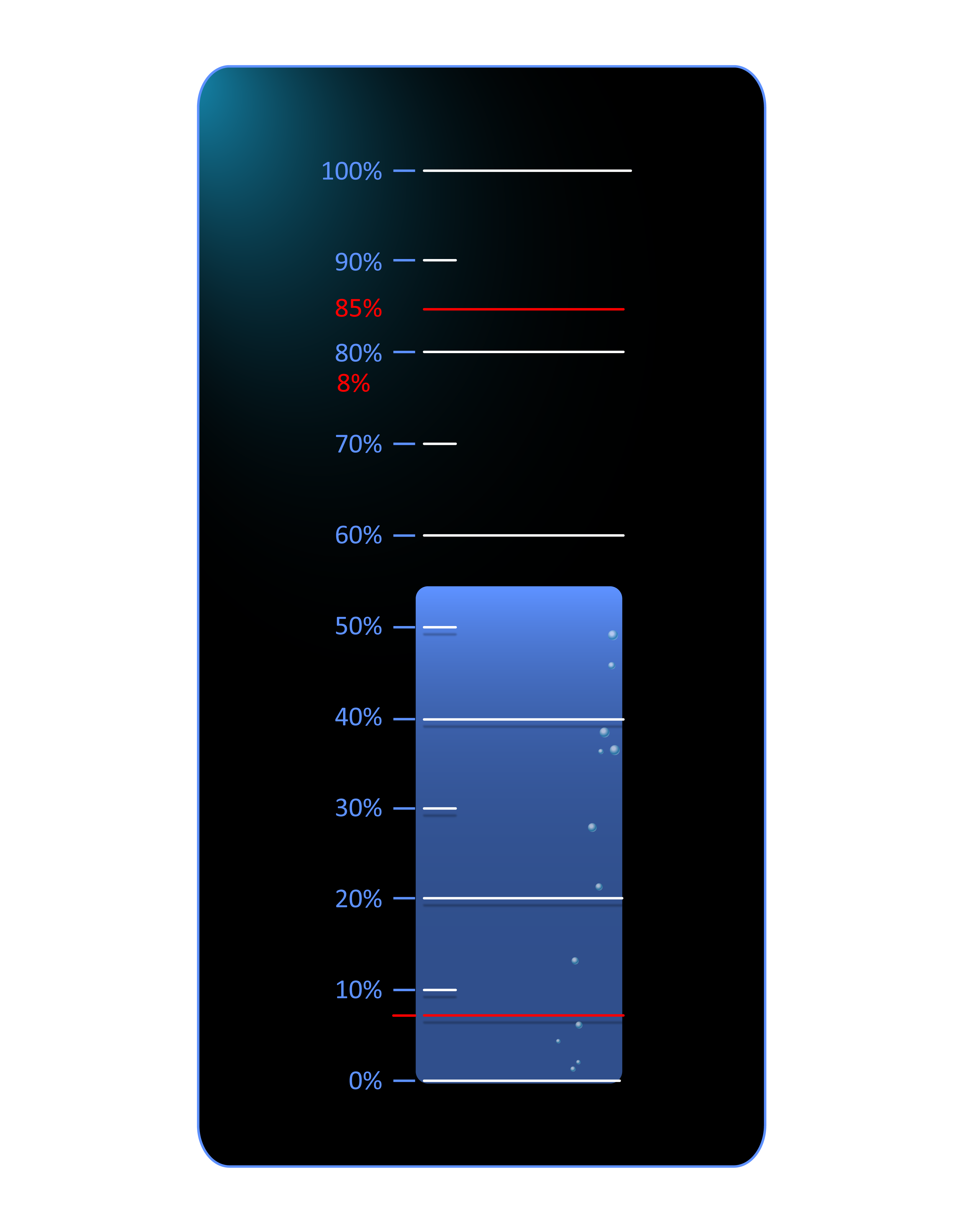
Gobius C Basic — micro radar on top of the tank, 2 mm resolution, a stepless 0–100 %.
Rung two
On the screens the boat already has
Bigger yachts, more tanks, and the last thing anyone wants is another app to open. The chartplotter at the helm is where the crew already looks.
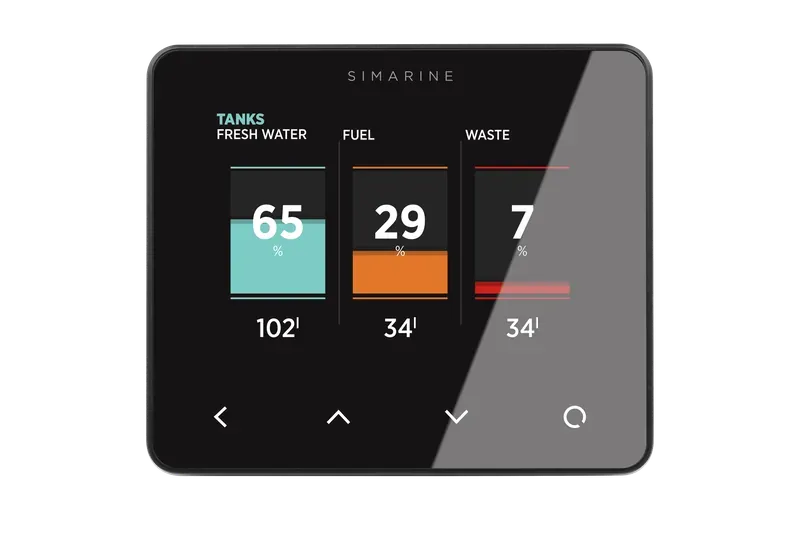
Gobius C for NMEA 2000 puts each tank on the boat’s own network. Fresh water, black water, diesel — they appear next to depth and speed on the plotter, the MFD or an instrument display. One place, all tanks, whoever's steering. Levels and volumes go out as standard fluid-level data, so it is your own plotter drawing the tank page, not a Gobius screen bolted on beside it.
No plotter, just the round gauges in the panel? The Analog Outputs variant drives those and adds 4–20 mA and 0–5 V.
- Garmin
- Raymarine
- B&G
- Simrad
- Furuno
- Lowrance
The app carries on working alongside the network: set up from the phone, glance at the plotter thereafter.
Rung three
Checking the boat from the kitchen table
Some tanks matter most when you are nowhere near them. A holding tank left over the winter. A water tank at the summer house. A boat you visit at weekends and worry about in between.
If you have a Victron system aboard, the Cerbo GX already does this job for the batteries and solar. A Cerbo GX or Ekrano GX reads Gobius volumes off the network, so the tanks appear on the GX screen and in the same remote dashboard as the batteries.
The honest condition: to see it from home, you need an internet connection on the boat. A 4G router, marina wifi, whatever you can get. Without one, you still have the tanks on the Cerbo GX screen and the plotter — you just have to be there to look.
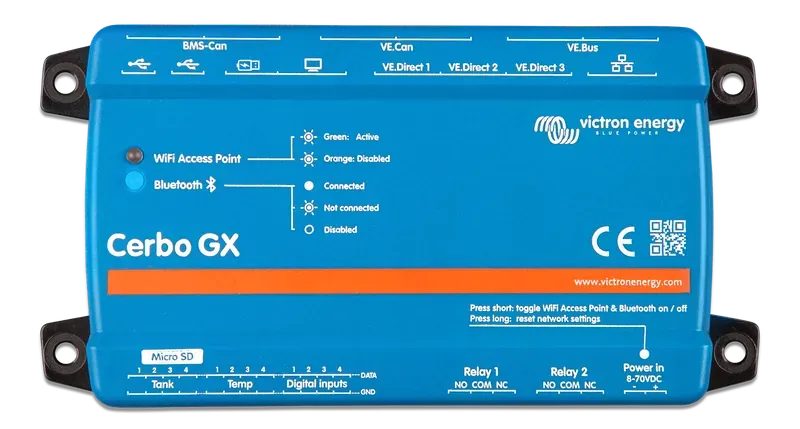
Rung three is rung two plus a GX device and a connection. The sensor and its cable stay exactly as they were.
| Measurement | Micro radar on top of the tank · 2 mm resolution· stepless 0–100 % |
|---|---|
| Tank depth | 200–4500 mm |
| Power & sealing | 12–24 V DC · IP 66 |
| Tank material | Fully external on plastic, polyethylene and fibreglass. A metal tank needs a small port in the tank top. |
| On the network | NMEA 2000 fluid level · selectable tank type and instance |
| Victron | Cerbo GX, Ekrano GX — remote viewing needs internet aboard |
| Variants | Basic · Analog Outputs · NMEA 2000 |
Gobius Pro is the other family: glued to the outside of a side wall, reading through any material — metal included — with nothing drilled. One fixed level point per sensor, an alarm rather than a percentage. Compare the two →
Questions
NMEA 2000 and Victron: asked and answered
Which Gobius connects to NMEA 2000?
Gobius C for NMEA 2000. It puts each tank on the boat's NMEA 2000 network, so the chartplotter shows the volume next to depth and speed, and it also works in the Gobius app. Gobius Pro and Gobius Original do not connect to NMEA 2000.
Does Gobius work with Victron Cerbo GX?
Yes. Gobius C, all 3 versions, reads on Victron Cerbo GX and Ekrano GX over Bluetooth, so the tanks appear on the same dashboard as the batteries. With a connection aboard, you can check them from home too.
Can I start with the app and add the plotter later?
The sensor and where it sits stay the same; only the variant decides what you can connect it to. If the plotter or a view from home is even a maybe, choose Gobius C for NMEA 2000 from the start.
Start on the rung you actually need
Fit the sensor, use the free app tomorrow, and climb later if the boat grows into it.