


Industry · plant, process and site tanks
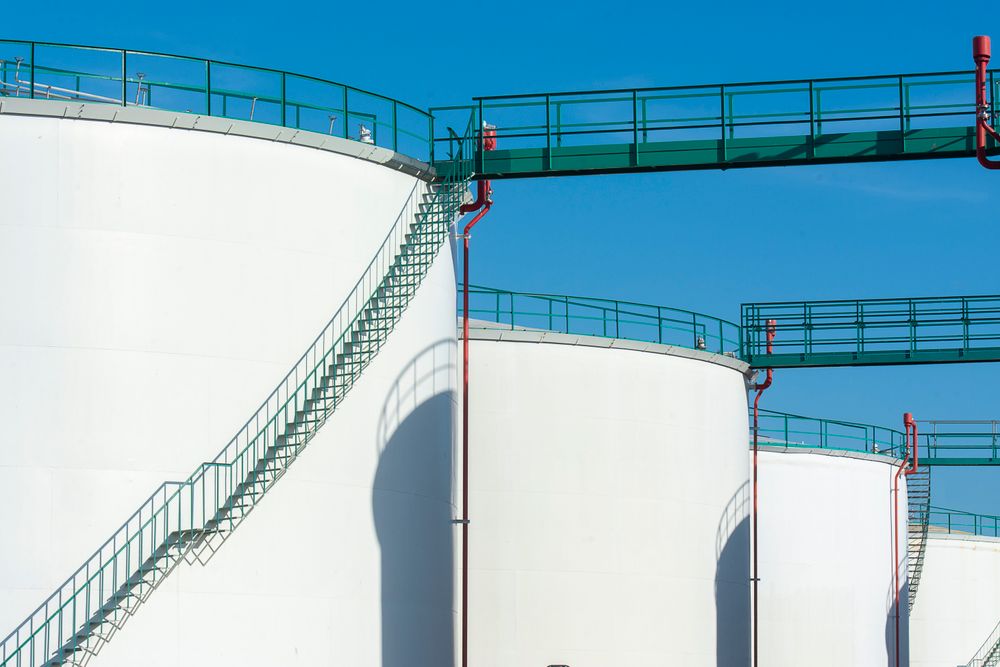
Measure the tank without breaching it
A Gobius sensor sits outside the tank and reads through the wall. No wetted parts, no new penetrations to seal or certify, and nothing inside the tank to service.
- No wetted parts
- Nothing inside to service
- Fits without emptying the tank
Why external
The measurement moves outside the tank
Every conventional gauge has to cross the tank wall — a nozzle, a gland, a probe in the medium. That crossing is what gets sealed, certified and eventually replaced. Measuring from outside removes it.
No wetted part
Nothing is immersed, so chemical compatibility of the sensor is not a question you have to answer.
No new penetration
No nozzle, no gland, no gasket to age. The vessel keeps the wall it was signed off with.
Nothing to service inside
No probe to pull, clean or recalibrate, and no reason to open a tank to maintain it.
No shutdown to fit it
Where the sensor is fully external it goes on a full tank that is still in service.
Awkward tanks stay closed
A sealed, buried or hard-to-reach vessel is gauged without an entry permit. The instrument stays outside.
Reversible
The asset is not modified. A sensor can be moved to another vessel, or taken off entirely.
Choosing
The wall decides which sensor
Gobius C is a micro radar on top of the tank: stepless 0–100 %, 2 mm resolution, depths 200–4500 mm. Radar cannot pass through metal, so C is fully external on polyethylene and fiberglass; on steel, stainless steel, or aluminum, it needs a small port fitted in the tank top.
Gobius Pro glues to the outside of the tank wall and reads from the side through any material, steel included, with nothing drilled. Each sensor is one fixed alarm point rather than a percentage; several Pro give a stepped picture, and a Pro can switch a lamp, buzzer or pump.
- Water
- Diesel
- Petrol
- Oil
- Black, grey & waste water
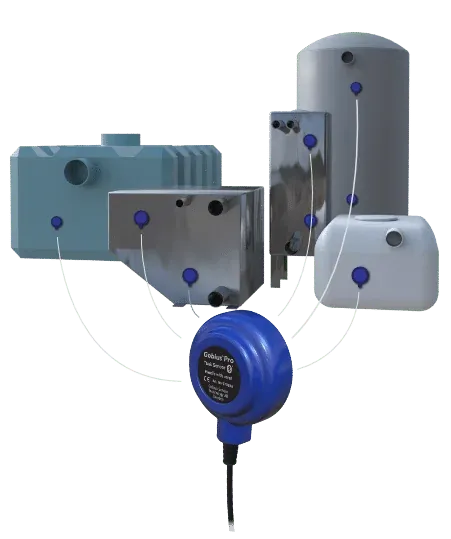
Gobius Pro wall limits: stainless steel & steel <3 mm, aluminium <5 mm, polythelenetic and plastic <12 mm, fibreglass <8 mm. Full side-by-side comparison.
On site
Many tanks, one system — and the exact volume or level where it is needed
Sensors are independent, so a site can start with the tanks that cause the most trouble and add the rest later.
Into existing instrumentation
The Gobius C Analog Outputs variant drives 0–190 / 240–33 Ohm gauges, 4–20 mA or 0–5 V — straight into a panel instrument or an analog gauge.
Onto a network
Where the installation runs NMEA 2000, levels go on the bus and existing displays pick them up. See network integration.
Straight to an actuator
Gobius Pro switches a lamp, a buzzer or a pump itself when its point is crossed.
In the app
Commissioning, calibration, and live volume over Bluetooth. No hub, no site network, no cloud account.
Mixed materials, one system
Polythelene, fibreglass and metal vessels run side by side, with no wiring run between tanks.
Supply and rating
12–24 V DC, IP 66, CE / EMC certified. Designed in Sweden.
Site-built vessels rarely hold what the drawing says. The Gobius Tank Calculator is a separate, standalone app that profiles level against volume for one specific tank. It requires a Gobius C sensor and does not work with Gobius Pro.
Before you specify
Talk to an engineer, not to a shopping cart
Industrial jobs are rarely one sensor bought off a page. Send us the tank list and we will tell you what fits.
If a tank falls outside what Gobius does well, you will hear that in the first reply.
| Tanks | How many, and roughly what size |
|---|---|
| Material | Plastic, PE, fibreglass, steel, stainless or aluminium — wall thickness if known |
| Medium | All kind of fluids |
| Access | Can you reach the tank top? Is there an existing opening? |
| Requirement | Stepless measuring with 2 alarms |
| Output | App, analog gauge or input, network, or a switched load |
Volume pricing and OEM terms are quoted per project.
Questions
Industry — frequently asked
Can a sensor be fitted while the tank is in service?
Yes wherever the sensor is fully external: Gobius C on plastic, polyethylene or fibreglass, and Gobius Pro on any material within its wall limits.
Does the medium matter?
The sensor never touches it. Gobius C and Pro are used with water, diesel, petrol and oil, and with black, grey and waste water. The wall material and its thickness matter more than the liquid does.
Do you hold a hazardous-area approval?
No. Gobius is CE / EMC certified, and we make no explosion-proof or hazardous-area claim. If your specification calls for one, say so at enquiry stage.
Send us your tank list
Materials, sizes and what you need to know about each application. We will come back with what fits — and what does not.